
Defect-controlled optical-electrical coupling in Ta-doped ZnO thin films deposited by magnetron sputtering
Method
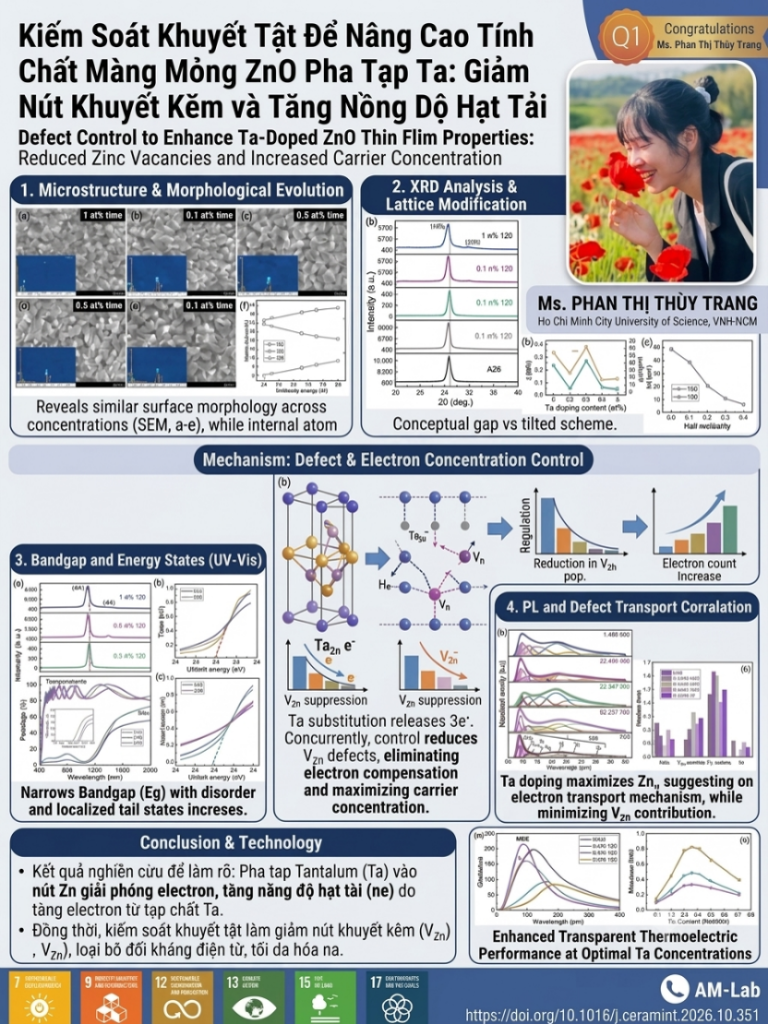
Undoped ZnO and Ta-doped ZnO (TZO) thin films (~1000 nm thick) were deposited on glass substrates by DC magnetron sputtering at 500 °C, using ZnO–Ta2O5 powder targets with nominal Ta contents of 0.1, 0.5, 0.7 and 1 at%. Structure, composition, optical and electrical properties were characterized by XRD, FESEM/EDX, UV-Vis spectroscopy, photoluminescence (PL) and Hall-effect measurements.
Key Finding
All films keep the single-phase wurtzite structure with preferred (002) orientation. The 0.5 at% Ta film shows the highest (002) intensity, the lowest residual stress, and the highest carrier concentration and mobility, while the average visible transmittance stays above 80%. The enhanced conductivity is attributed to substitutional Ta5+ donors together with donor-type intrinsic defects (Zni, VO) and reduced compensation by zinc-vacancy (VZn) acceptors, as indicated by Urbach energy and PL analysis.
Notable Numbers
Significance
The study clarifies how controlled Ta incorporation tunes defect states, crystal structure, optical band gap and electrical transport in ZnO, and shows that 0.5 at% Ta gives the best balance between optical transparency and electrical conductivity. The optimized film is a promising transparent conductive oxide (TCO) candidate for transparent electrodes, solar cells, UV photodetectors and gas sensors.
Overview
Ta-doped ZnO (TZO) thin films with different Ta concentrations were deposited by DC magnetron sputtering to investigate the effects of Ta incorporation on their structural, optical, and electrical properties. All the films retained the single-phase wurtzite structure with a preferred (002) orientation, while Ta incorporation induced concentration-dependent variations in lattice parameters and residual stress. Among the investigated samples, the 0.5 at% Ta-doped film exhibited the highest (002) diffraction intensity and lowest residual stress, together with the highest carrier concentration and mobility. The films maintained high optical transparency, with an average visible transmittance above 80%, while the optical band gap showed only minor variation. The increase in Urbach energy and the concentration-dependent photoluminescence emissions indicated changes in structural disorder and intrinsic defect states. The enhanced electrical conductivity at 0.5 at% Ta may arise from the combined contributions of substitutional Ta donors and changes in intrinsic defect-related states, together with reduced compensation by acceptor-type defects. These results demonstrate that controlled Ta incorporation can effectively tune the structural, defect, optical, and electrical properties of ZnO, with 0.5 at% Ta providing a favorable balance between optical transparency and electrical conductivity.