3Transparent Conducting Oxide (TCO) Semiconductors
Bán dẫn oxit dẫn điện trong suốt (TCO)
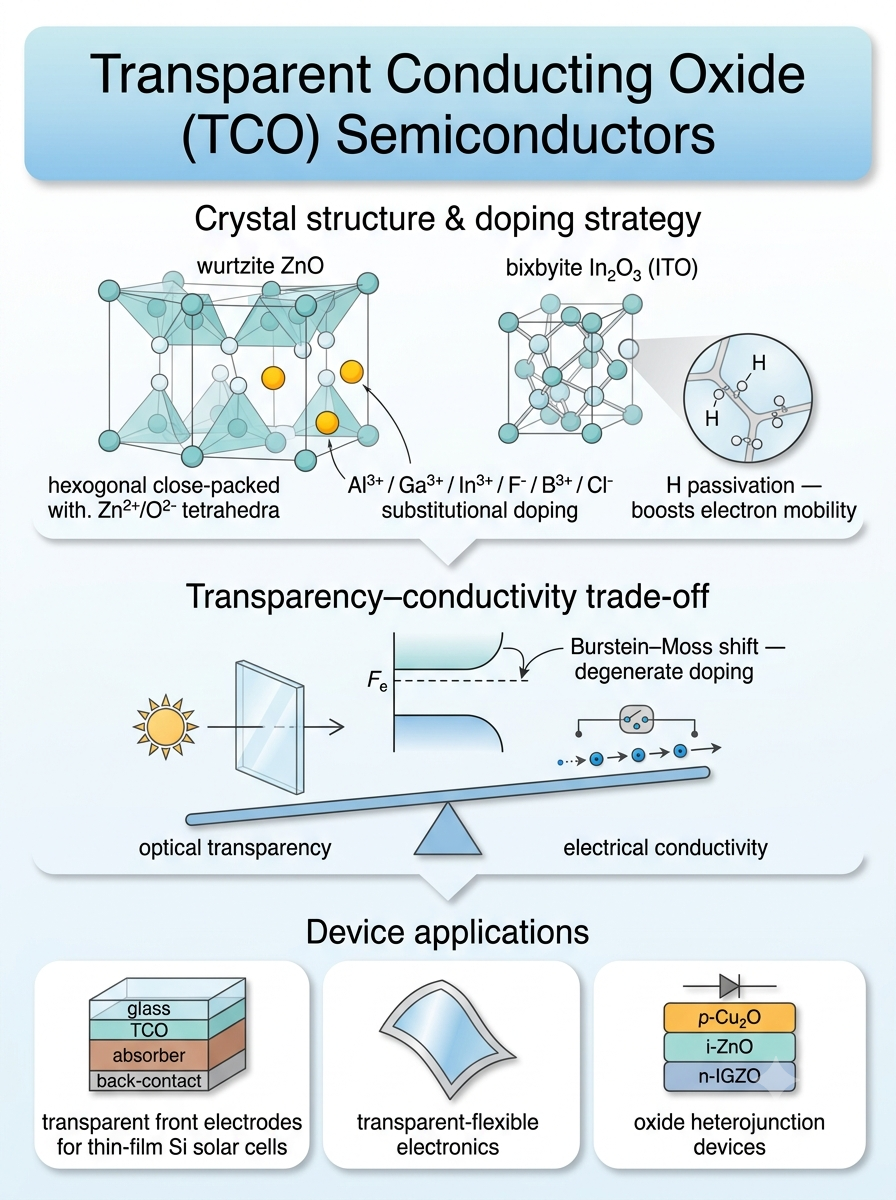
The Lab is a long-standing contributor to wide-bandgap TCO semiconductor research, with ZnO-based films and Sn-doped In₂O₃ (ITO) as flagship material systems. Our work targets the intrinsic semiconductor trade-off between optical transparency and electrical conductivity, governed by degenerate doping and the Burstein–Moss shift. We systematically investigate single- and co-doping strategies — Al, Ga, In, F, B, and Cl substitutional doping, together with hydrogen incorporation/passivation — to raise free-carrier concentration and electron mobility while preserving visible-light transparency, and to understand how each dopant's ionic radius, electronegativity, and solubility limit affect grain-boundary scattering, defect hierarchy, and structural distortion. Hydrogen has proven a particularly powerful lever in our films, simultaneously activating shallow donors and passivating grain-boundary traps to unlock high-mobility, high-performance electrodes (H-doped, Al–H and Ga–H co-doped ZnO). Beyond electrode-grade conductivity, we also exploit ZnO's semiconducting versatility for functional heterojunction devices, including p-Cu₂O/i-ZnO/n-IGZO heterojunctions and IGZO/ZnO/Cu₂O-based thin-film solar cells, and transparent-flexible TCO substrates for optoelectronic and thermoelectric device integration. This research underpins applications in transparent electrodes for thin-film silicon solar cells, flexible/transparent electronics, and TCO front-contact layers for photovoltaic and energy-harvesting devices.
Phòng thí nghiệm đã có nhiều năm đóng góp cho nghiên cứu bán dẫn TCO vùng cấm rộng, với các màng nền ZnO và In₂O₃ pha tạp Sn (ITO) là những hệ vật liệu tiêu biểu. Nghiên cứu của chúng tôi hướng đến sự đánh đổi nội tại của chất bán dẫn giữa độ trong suốt quang học và độ dẫn điện, được chi phối bởi pha tạp suy biến và dịch chuyển Burstein–Moss. Chúng tôi khảo sát có hệ thống các chiến lược pha tạp đơn và đồng pha tạp — thay thế bằng Al, Ga, In, F, B và Cl, cùng với đưa vào/thụ động hóa bằng hydro — nhằm tăng nồng độ hạt tải tự do và độ linh động điện tử mà vẫn giữ độ trong suốt trong vùng khả kiến, đồng thời hiểu rõ bán kính ion, độ âm điện và giới hạn hòa tan của từng tạp chất ảnh hưởng thế nào đến tán xạ biên hạt, thứ bậc khuyết tật và biến dạng cấu trúc. Hydro là một đòn bẩy đặc biệt hiệu quả trong các màng của chúng tôi, vừa kích hoạt các donor nông vừa thụ động hóa các bẫy ở biên hạt, giúp tạo ra điện cực có độ linh động cao và hiệu năng tốt (ZnO pha tạp H, đồng pha tạp Al–H và Ga–H). Ngoài độ dẫn điện ở mức điện cực, chúng tôi còn khai thác tính đa dụng bán dẫn của ZnO cho các linh kiện dị thể chức năng, bao gồm dị thể p-Cu₂O/i-ZnO/n-IGZO và pin mặt trời màng mỏng nền IGZO/ZnO/Cu₂O, cùng các đế TCO trong suốt – dẻo để tích hợp linh kiện quang điện và nhiệt điện. Nghiên cứu này là nền tảng cho các ứng dụng như điện cực trong suốt cho pin mặt trời silic màng mỏng, điện tử dẻo/trong suốt và lớp tiếp xúc mặt trước TCO cho các linh kiện quang điện và thu hoạch năng lượng.
Selected publications / Công bố tiêu biểu
- Hydrogen roles approaching ideal electrical and optical properties for undoped and Al doped ZnO thin films
- Synergy of indium doping and hydrogenation for good-performance and high-mobility ZnO electrode films
- High-mobility sputtered F-doped ZnO films as good-performance transparent-electrode layers
- Controlling thickness to tune performance of high-mobility transparent conducting films deposited from Ga-doped ZnO ceramic target
- A depression in structural distortion to improve transparent ZnO electrodes by bismuth doping